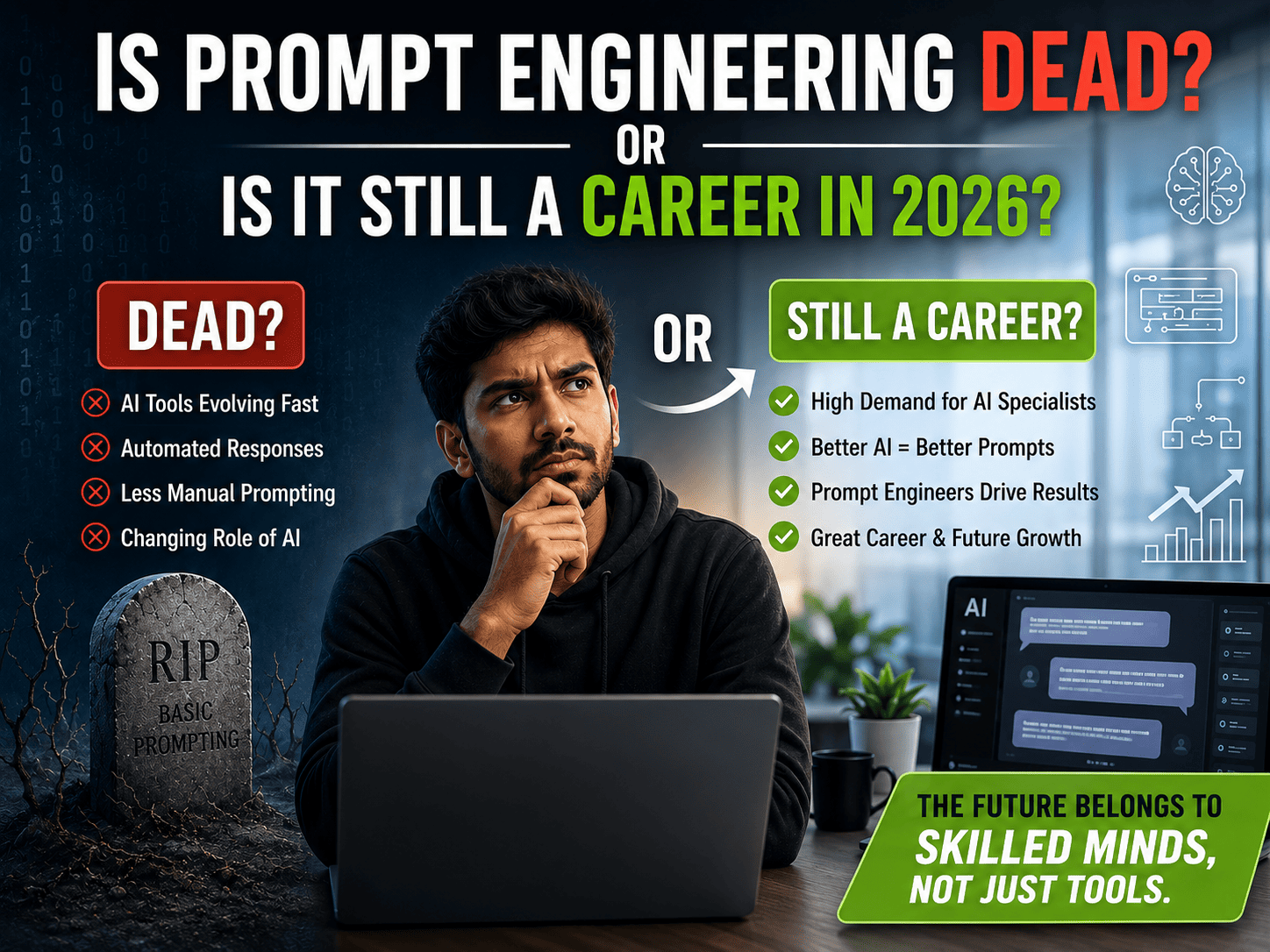
Is Prompt Engineering Dead? Or Is It Still a Career in 2026?
When ChatGPT became popular, a completely new career emerged almost overnight: Prompt Engineering. Companies, freelancers, marketers, developers, and content creators suddenly realized that the quality of AI output depended heavily on the quality of the instructions given to AI models.
As a result, Prompt Engineering quickly became one of the most talked-about technology skills in the world. Social media influencers claimed it was the "career of the future," while companies started looking for professionals who could effectively communicate with Artificial Intelligence systems.
However, in 2026, many students and professionals are asking an important question:
The answer is simple: Prompt Engineering is not dead, but it has evolved significantly.
What Is Prompt Engineering?
Prompt Engineering is the process of designing instructions, commands, and conversations that help Artificial Intelligence systems generate accurate, useful, and high-quality responses.
For example, instead of asking:
Write an article about Artificial Intelligence.
A Prompt Engineer might write:
Act as an SEO expert and create a 3000-word blog about Artificial Intelligence for students. Include headings, tables, FAQs, keywords, and practical examples.
The second prompt produces significantly better results because it provides clear context, objectives, and formatting instructions.
Why Prompt Engineering Became So Popular
Between 2023 and 2025, the demand for AI-related skills exploded due to the rapid growth of:
- ChatGPT
- Google Gemini
- Claude AI
- Microsoft Copilot
- Midjourney
- Generative AI Tools
- AI Content Creation Platforms
Businesses quickly realized that people who understood how to interact with AI could increase productivity, automate tasks, generate content, improve customer service, and accelerate software development.
Has Prompt Engineering Disappeared?
No.
What has changed is the role itself.
Modern AI systems are far more intelligent than earlier versions. Today's AI models can understand context, intent, and natural language much better than before. This means users no longer need extremely complex prompts to get useful answers.
As a result, companies rarely hire people solely for writing prompts. Instead, Prompt Engineering has become a skill that is integrated into broader AI-related careers.
The Evolution of Prompt Engineering
| Earlier Role | Modern AI Role |
|---|---|
| Prompt Engineer | AI Engineer |
| Prompt Writer | AI Automation Specialist |
| ChatGPT Expert | AI Consultant |
| Prompt Designer | AI Agent Developer |
| Content Prompt Specialist | Generative AI Strategist |
The Rise of AI Agents
One of the biggest technology trends of 2026 is the rise of AI Agents.
Unlike traditional AI chatbots, AI Agents can:
- Perform multiple tasks automatically
- Access databases
- Use APIs
- Search the internet
- Analyze information
- Make decisions based on goals
- Execute workflows without human intervention
Modern platforms such as:
- OpenAI Agents
- CrewAI
- AutoGen
- n8n AI Workflows
- LangChain
- LLPhant
- Microsoft Copilot Studio
are creating entirely new career opportunities beyond traditional Prompt Engineering.
Skills That Are More Valuable Than Prompt Engineering Alone
Prompt Engineering remains useful, but students should combine it with other high-demand skills.
- Artificial Intelligence
- Generative AI
- AI Agents Development
- Automation Workflows
- Python Programming
- Data Science
- Machine Learning
- Cloud Computing
- API Integration
- RAG (Retrieval-Augmented Generation)
- Vector Databases
- Business Process Automation
Can Students Still Learn Prompt Engineering?
Absolutely.
Prompt Engineering is still one of the easiest entry points into the world of Artificial Intelligence. It helps students understand how AI thinks, processes information, and generates responses.
Students can use Prompt Engineering for:
- Content Creation
- Digital Marketing
- SEO Optimization
- Research
- Programming Assistance
- Business Automation
- Data Analysis
- Academic Learning
However, students should view Prompt Engineering as a foundation rather than a complete career path.
Top AI Careers in 2026
| Career | Demand Level |
|---|---|
| AI Engineer | ★★★★★ |
| AI Agent Developer | ★★★★★ |
| Machine Learning Engineer | ★★★★★ |
| Data Scientist | ★★★★★ |
| AI Automation Specialist | ★★★★★ |
| Prompt Engineering Expert | ★★★★☆ |
What Should Students Learn in 2026?
Students who want to build future-proof careers should focus on developing a combination of technical and AI-related skills.
- Generative AI
- Prompt Engineering
- AI Agents
- Python Programming
- Data Science
- Machine Learning
- Cloud Technologies
- Automation Platforms
- Problem Solving
- Critical Thinking
The future belongs to people who know how to work with AI, automate processes, and create intelligent solutions rather than simply use AI tools.
Why AI Skills Matter More Than Ever
Artificial Intelligence is transforming every industry, including education, healthcare, finance, manufacturing, cybersecurity, digital marketing, software development, and customer service.
Companies are increasingly looking for professionals who understand AI technologies and can apply them to solve real-world business problems.
For students in Vadodara and across India, learning AI-related skills today can create opportunities for high-paying jobs, freelancing, entrepreneurship, and global remote work opportunities.
Conclusion
Prompt Engineering is not dead. Instead, it has become part of a much larger Artificial Intelligence ecosystem. While companies may not hire professionals solely to write prompts anymore, they actively seek individuals who can combine Prompt Engineering with AI development, automation, AI agents, data science, and problem-solving skills.
The future of technology belongs to people who understand how to collaborate with Artificial Intelligence. Students who start learning these skills today will be better prepared for the careers of tomorrow.
