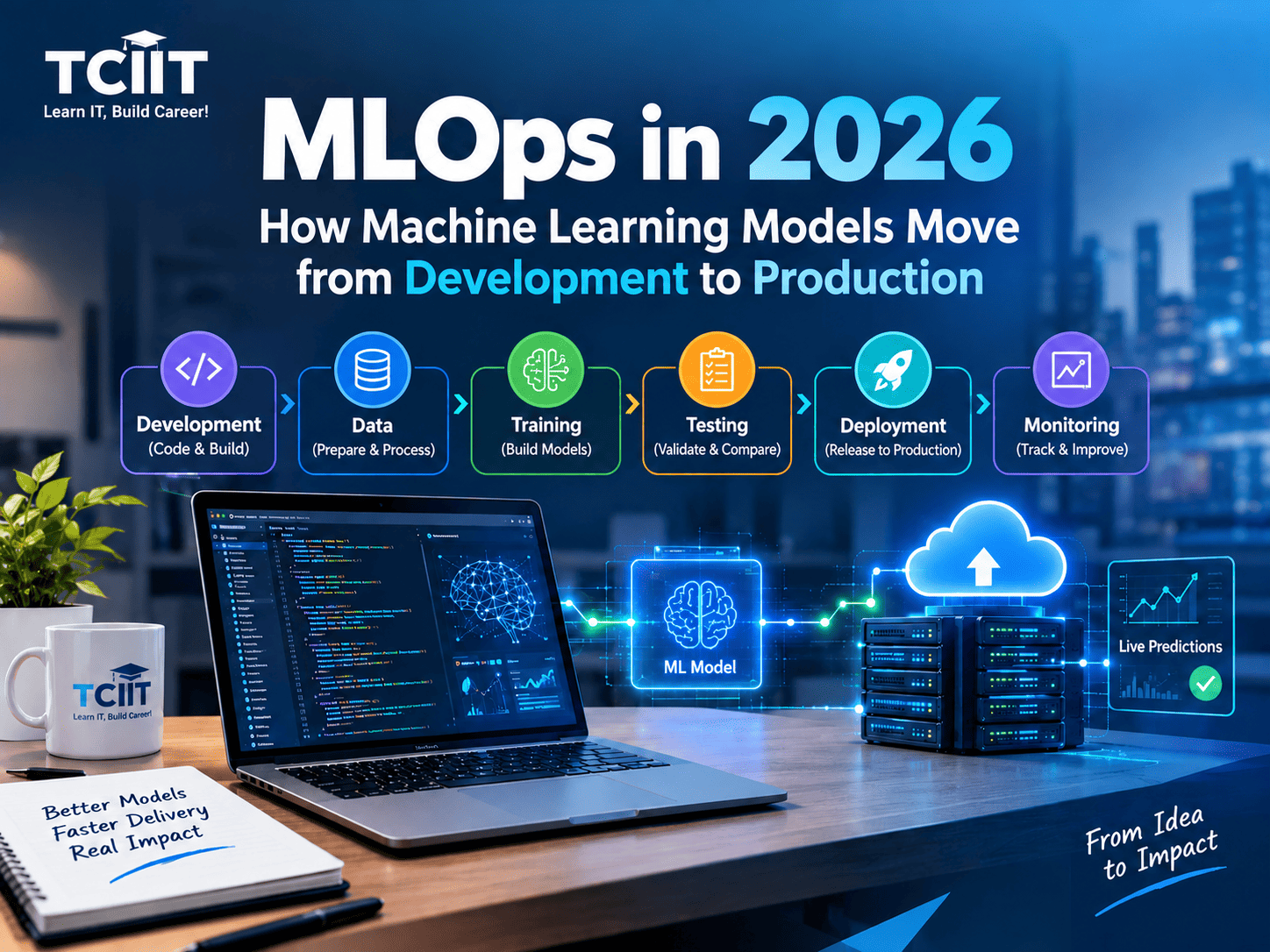
MLOps in 2026: How Machine Learning Models Move from Development to Production
Discover how MLOps combines Machine Learning, software engineering,
automation and deployment to move models from development into
reliable production environments. Explore essential tools, workflows,
practical projects and career opportunities in 2026.
Machine Learning is transforming how businesses analyze information,
make predictions and automate different tasks. From recommendation
systems and fraud detection to demand forecasting and intelligent
applications, Machine Learning models are becoming part of many
digital products and business workflows.
However, developing a model is only one part of the process.
A model that performs well during experimentation must also be
deployed, monitored, maintained and updated before it can deliver
consistent value in a real-world environment.
This is where MLOps becomes important. MLOps brings
together Machine Learning, software development, data engineering
and operational practices to make the development and deployment
of ML systems more organized and repeatable.
MLOps helps teams manage the complete Machine Learning lifecycle,
from data preparation and model training to deployment,
monitoring and continuous improvement.
MLOps stands for Machine Learning Operations. It describes practices
and technologies used to develop, deploy, monitor and maintain
Machine Learning systems in a more reliable and scalable way.
Traditional software applications mainly depend on code, while
Machine Learning applications also depend on datasets, trained
models, features, evaluation results and model versions. These
additional components make ML systems more complex to maintain.
MLOps helps teams organize these components and establish repeatable
workflows throughout the Machine Learning lifecycle.
Data Collection → Gather relevant training data
Model Development → Train and experiment with models
Model Evaluation → Check performance and quality
Deployment → Make the model available for use
Monitoring → Track performance and operational health
Retraining → Update models when required
As organizations integrate Machine Learning into products and
business operations, they need reliable ways to manage models after
development. A model may become less accurate as customer behavior,
business conditions or incoming data changes.
MLOps provides practices for managing these changes, improving
reproducibility and helping teams maintain production systems.
It can also reduce repetitive manual work through automation.
Automate repetitive training, testing and deployment tasks.
Make model releases more consistent and easier to validate.
Detect operational issues and changes in model behavior.
Support model services as usage and business requirements grow.
Machine Learning and MLOps are closely connected, but they focus
on different parts of the process. Machine Learning focuses on
building models that learn patterns from data, while MLOps focuses
on managing those models throughout their operational lifecycle.
Data preparation
Feature engineering
Model training
Model evaluation
Experiment tracking
Model versioning
Automated deployment
Monitoring and maintenance
In practice, both areas work together. A Machine Learning engineer
may develop and evaluate a model, while an MLOps workflow helps
package, test, deploy and monitor that model in production.
Before learning MLOps tools, students should understand how a
Machine Learning project moves from an initial problem to a
working application.
Define the Problem → Collect Data → Prepare Data → Train Model →
Evaluate Model → Deploy Model → Monitor Results → Improve Model
This lifecycle is iterative rather than strictly linear. If a model
does not meet performance requirements, developers may need to
improve the dataset, adjust features, test another algorithm or
revise the deployment approach.
Python is widely used in Machine Learning, data processing,
automation and model-serving applications. Learning Python provides
a useful foundation for students who want to explore MLOps.
Beginners should become comfortable with variables, functions,
data structures, modules, file handling, exceptions and working
with libraries. Basic scripting skills are also useful for
automating routine tasks.
Variables • Functions • Lists and Dictionaries • Modules •
File Handling • Exceptions • Virtual Environments •
Packages • Automation Scripts
MLOps professionals need to understand how Machine Learning models
are trained and evaluated. Without this foundation, it can be
difficult to identify why a model fails or what should be monitored
after deployment.
Students can begin with supervised learning, unsupervised learning,
training and testing datasets, feature engineering, model evaluation
and the difference between overfitting and underfitting.
Training Data → Data used to fit a model
Testing Data → Data used to evaluate performance
Features → Input variables used by a model
Evaluation Metrics → Measurements used to assess results
Model Generalization → Ability to perform on unseen data
Machine Learning projects often involve multiple experiments,
code changes and model improvements. Version control helps teams
track changes, collaborate and return to earlier versions when
necessary.
Git is a widely used version control system. Students should learn
how to create repositories, commit changes, work with branches and
collaborate through platforms such as GitHub or GitLab.
Git • Repositories • Commits • Branches • Merge Requests •
GitHub • GitLab • Project Documentation
In Machine Learning, the final result depends not only on source code
but also on the dataset, configuration, training process and model
artifacts. Tracking these components makes experiments easier to
reproduce and compare.
Data and model versioning help teams identify which inputs and
configurations produced a particular result. They also make it
easier to investigate issues after a model has been deployed.
Track dataset versions and changes to training inputs.
Keep track of trained model versions and their metadata.
Record parameters, metrics and experiment results.
Make it easier to repeat and verify a training workflow.
Machine Learning developers may train many versions of a model
using different parameters, datasets and algorithms. Experiment
tracking provides a structured way to compare these attempts.
Tools such as MLflow can help teams log parameters, metrics,
artifacts and model information. This makes it easier to identify
which experiments performed well and why.
Parameters → Settings used during training
Metrics → Accuracy, precision, recall or other relevant measurements
Artifacts → Model files, charts and supporting outputs
Metadata → Dataset version, code version and experiment details
A Machine Learning model may work correctly on a developer's computer
but fail in another environment because of differences in dependencies,
package versions or system configuration.
Docker helps package an application and its dependencies into a
container, making the environment more consistent across development,
testing and deployment.
Containers • Images • Dockerfile • Dependencies • Ports •
Environment Variables • Container Registries • Basic Networking
Model deployment makes a trained model available to an application,
service or end user. One common approach is to expose a model through
an API so that other applications can submit inputs and receive
predictions.
Students can learn how to create a basic prediction API using a
Python web framework, package it in Docker and test it with sample
requests before exploring cloud deployment.
1. Train and save the model
2. Build an API for predictions
3. Validate inputs and handle errors
4. Package the application in a container
5. Deploy to a suitable environment
6. Test and monitor the deployed service
Continuous Integration and Continuous Delivery or Deployment,
commonly called CI/CD, help teams automate testing and software
release workflows.
In MLOps, CI/CD can include testing code, validating data schemas,
checking model behavior, building containers and deploying approved
model services. The exact workflow depends on the project and its
operational requirements.
Code Change → Automated Tests → Build → Model Validation →
Package → Deployment → Health Checks
A Machine Learning pipeline organizes multiple steps into a
repeatable workflow. Instead of manually running every task,
teams can connect data preparation, training, evaluation and
model registration into a managed process.
Pipeline tools can help manage dependencies between steps, track
outputs and rerun workflows when data or configuration changes.
Examples include Kubeflow Pipelines and cloud-specific ML workflow tools.
Data Validation → Check input quality
Data Preparation → Clean and transform data
Model Training → Fit the selected algorithm
Evaluation → Compare performance against requirements
Model Registration → Record an approved model version
Deploying a model is not the end of the MLOps process. After
deployment, teams need to understand whether the service is
functioning correctly and whether the model continues to meet
its performance requirements.
Monitoring can include response time, error rates, resource usage,
input data patterns and model quality. When reliable labels become
available, teams can also evaluate prediction performance over time.
Monitor availability, failures and response times.
Identify changes in incoming data distributions.
Evaluate prediction quality when suitable ground truth is available.
Track CPU, memory and other relevant infrastructure metrics.
Production data can change over time. For example, customer
purchasing behavior, product demand or user preferences may differ
from the patterns represented in the original training dataset.
Data drift generally refers to changes in incoming data distributions.
Model performance can also decline when relationships between inputs
and outcomes change. Monitoring helps teams investigate these changes
and decide whether further action is needed.
Detect Changes → Investigate the Cause → Evaluate Model Quality →
Prepare Updated Data → Retrain if Needed → Validate Before Release
Retraining should not happen blindly. Teams need suitable validation,
performance checks and release controls before replacing a production
model with a newer version.
The MLOps ecosystem includes tools for experiment tracking, data
versioning, containerization, workflow automation, deployment and
monitoring. Beginners do not need to learn all of them at once.
Build scripts, prepare data and develop Machine Learning applications.
Track code changes and collaborate on projects.
Track experiments and manage model-related artifacts and metadata.
Package applications and dependencies into containers.
Automate testing and selected CI/CD workflows.
Orchestrate containerized applications in suitable environments.
Collect and visualize operational metrics for supported systems.
Explore managed model training, deployment and monitoring services.
Practical projects help students connect Machine Learning concepts
with software engineering and deployment workflows. A portfolio
should demonstrate not only model accuracy but also how the model
is tested, packaged, deployed and maintained.
Train a simple model, expose predictions through an API and
test the service using sample inputs.
Use MLflow to record training parameters, evaluation metrics
and model artifacts.
Package a trained model and its API using Docker and test it
in a consistent environment.
Automate code tests, build steps and deployment checks using
a CI/CD platform.
Track prediction requests, response times, errors and selected
model-quality indicators.
An MLOps portfolio should show how a Machine Learning model moves
from experimentation to a usable and maintainable application.
Employers and project reviewers need to understand the decisions
behind the workflow, not just see the final prediction.
Students can document their project architecture, code repository,
dataset preparation, evaluation results, deployment method, testing
strategy and monitoring approach.
Python Project • Git Repository • ML Experiment Tracking •
Model Evaluation • Docker Image • Prediction API • CI/CD Workflow •
Monitoring Dashboard • Project Documentation
MLOps combines skills from Machine Learning, software engineering,
cloud infrastructure and automation. Career requirements vary by
employer, and many specialized roles expect prior experience in
programming, deployment or production systems.
Develop and maintain workflows for training, deployment and
monitoring Machine Learning systems.
Develop, evaluate and integrate ML models into applications.
Build and maintain systems that collect, transform and deliver data.
Automate software delivery and manage infrastructure and operations.
Support cloud infrastructure, deployment environments and services.
Help build and operate platforms that support AI and ML workloads.
Beginners can approach MLOps step by step instead of trying to learn
every tool simultaneously. The timeline depends on prior programming
knowledge, learning time and project complexity.
Learn Python programming, command-line basics and version control.
Train simple models and understand datasets, metrics and evaluation.
Record experiment parameters, metrics and model versions.
Package an ML application and serve predictions through an API.
Automate testing, packaging and controlled deployment workflows.
Track service health, data changes and model performance.
Demonstrate the complete lifecycle from model training to production monitoring.
MLOps continues to evolve alongside cloud computing, automation,
generative AI and increasingly complex Machine Learning applications.
Organizations need ways to manage models, datasets, deployment
pipelines and operational risks throughout their lifecycle.
Related areas include automated model evaluation, feature management,
model observability, efficient inference, governance and the operational
management of generative AI applications. These areas build on core
principles such as testing, monitoring, versioning and reproducibility.
Python + Machine Learning + Git + Docker + CI/CD +
Cloud Infrastructure + Model Monitoring + Practical Projects
MLOps connects Machine Learning with the engineering practices
required to operate real-world applications. Students interested
in this field should develop programming fundamentals, understand
model development and gain experience with deployment workflows.
Practical projects can help learners understand how code, data,
models, APIs and monitoring work together in a complete application.
At TCIIT, students can explore technology-focused learning and
practical IT skills as part of their journey toward emerging
technology fields.
MLOps plays an important role in moving Machine Learning models
from experimentation to production. It combines model development
with version control, automated testing, deployment, monitoring
and ongoing maintenance.
Students who want to explore this field should begin with Python,
Machine Learning fundamentals and Git before progressing toward
experiment tracking, Docker, CI/CD, model deployment and monitoring.
In 2026, developing a foundation in
Python, Machine Learning, MLOps tools and practical deployment projects
can help learners prepare for further study and explore career
opportunities in Machine Learning engineering and AI infrastructure.
1. Introduction
2. What Is MLOps?
The MLOps Workflow
3. Why Is MLOps Important in 2026?
Automation
Reliability
Monitoring
Scalability
4. Machine Learning vs MLOps
Machine Learning
MLOps
5. Understand the Machine Learning Lifecycle
From Data to Production
6. Step 1: Learn Python for MLOps
7. Step 2: Understand Machine Learning Fundamentals
Essential ML Concepts
8. Step 3: Learn Git and Version Control
9. Step 4: Understand Data and Model Versioning
Data Versioning
Model Versioning
Experiment Tracking
Reproducibility
10. Step 5: Learn Experiment Tracking
What Should You Track?
11. Step 6: Learn Docker and Containerization
12. Step 7: Deploy Machine Learning Models
Basic Model Deployment Workflow
13. Step 8: Understand CI/CD for Machine Learning
An Automated MLOps Pipeline
14. Step 9: Build Machine Learning Pipelines
Example Training Pipeline
15. Step 10: Monitor Models in Production
Service Health
Data Drift
Model Quality
Resource Usage
16. Understand Data Drift and Model Drift
17. Important MLOps Tools to Learn in 2026
18. Practical MLOps Projects for Students
19. Build an MLOps Portfolio
20. Career Opportunities in MLOps
MLOps Engineer
Machine Learning Engineer
Data Engineer
DevOps Engineer
Cloud Engineer
AI Platform Engineer
21. MLOps Career Roadmap 2026
22. Common MLOps Mistakes Beginners Should Avoid
23. The Future of MLOps
The Future Skill Combination
Build Practical Skills for the AI and MLOps Era
24. Frequently Asked Questions
25. Conclusion
